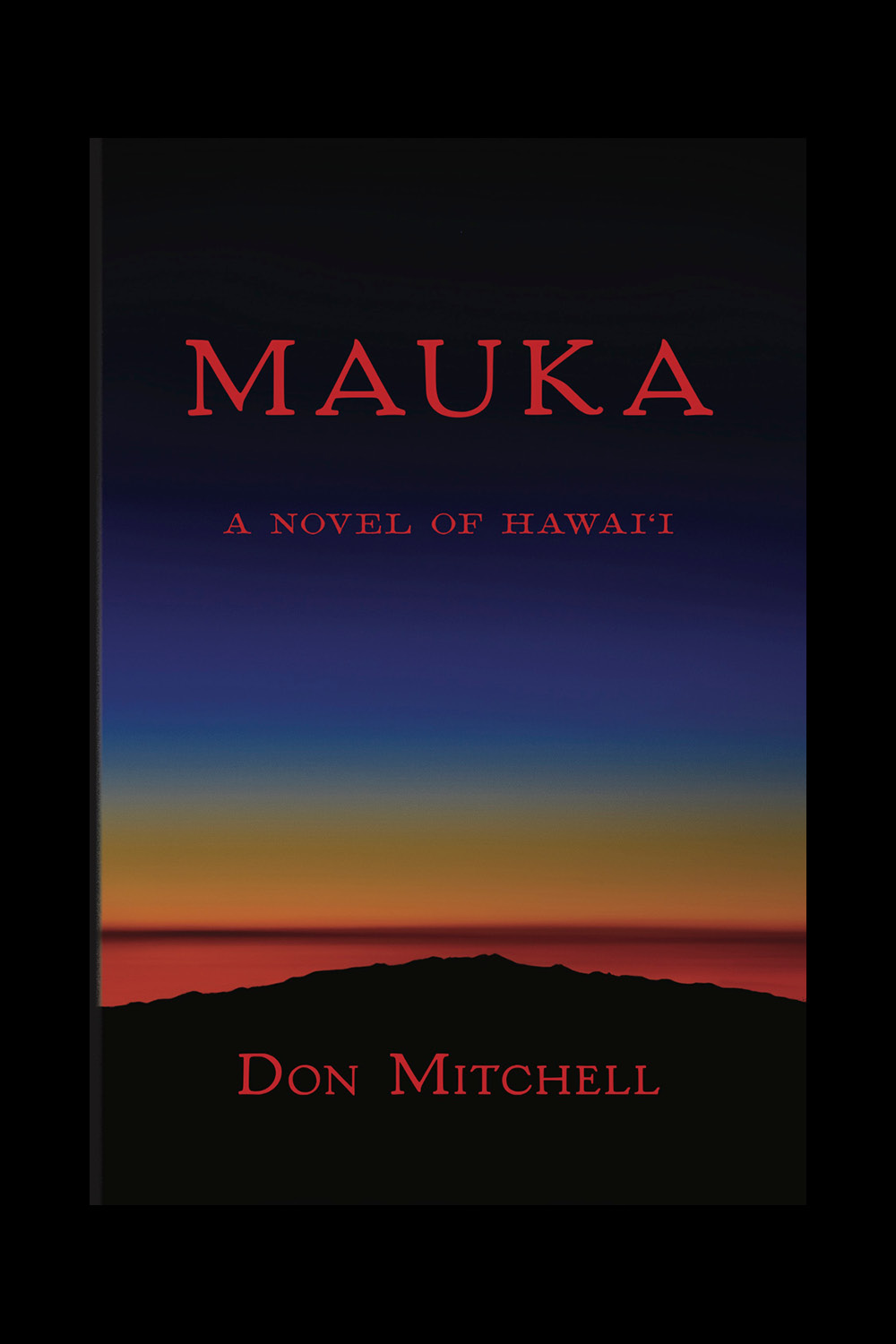
Mauka: A Novel of Hawai'i
Mauka: A Novel of Hawai'i





ISBN 9798990054394 October, 2026 $26 (Kindle $11.99)
DESCRIPTION
Mauka (Hawaiian for “to the mountain”) is a novel about the things we bury to keep going, and what it costs to finally set them down. It explores what happens when June Nakashima and Max Nelson, two old friends separated for sixty years by thousands of miles, reconnect in Hilo, Hawai‘i. It’s about the long tail of violence: how a sexual assault kept silent reshapes a personality, and how a death kept secret reshapes another. It’s also a love in old age story that takes seriously the bodies, the histories, the diminishments, and the unexpected discoveries, as two old loners join in running, hiking, being sexual and writing about it all. The dormant volcano Mauna Kea, on whose high barrens and forested lower slopes much of the novel is set, offers a kind of scale for measuring human connection—and wrongdoing.
REVIEWS
"Flush with geographical symbolism, Mauka is a thoughtful novel about late-life reckonings—and romance...an introspective novel whose heroes’ considerations of the past are both polysemous and surprising.” —Foreword Reviews
"Don Mitchell's Mauka —meaning "to the mountain"— is a dramatic, character-driven account set in a vividly described Hawaii......a well-written novel that should appeal to literary readers drawn to an unexpected, late-in-life romance.” — BlueInk
"Mitchell’s prose is patient, conversational, and unusually attentive to thinking itself. Dialogue often wanders into philosophy without losing the characters’ individuality...Mitchell captures essences of these lives and their home with care and beauty while exploring whether love at 70 is different from love at 20. Perfect for readers who appreciate love stories of experienced hearts laid bare...Mitchell movingly demonstrates how closed-off people with a shared past can, with time, begin to unlock each other.” —Booklife
“The author’s deep appreciation of the area’s geography, botany, and people shines through…fascinating…enlivened by strong character development and sometimes-beautiful prose.” — Kirkus
“Don Mitchell captures the essence of the stain of inhumanity on life in a small and intimate place, where the skeletons in our closet are buried under the detritus of our daily lives deeper than anywhere else. Mauka is an intimate portrait of the slow poison of shame and guilt, harrowing and heavy.” —Scott Kikkawa, Honolulu author of the best-selling “Sheik” Yoshikawa noir detective novels
"Mauka is at once a sensitive portrayal of older love, an interrogation of shame across cultures and generations, and an inventive exploration of what is possible in a dialogue with the past. Mitchell, a beautiful stylist, has a keen eye for the tender or humorous detail, and he imbues even the most philosophical passage with the thrum of suspense.” —Becky Cooper, best-selling author of We Keep the Dead Close
“There are two types of novels set in historical or geographical locations: one where the author is clearly winging it, and the other when they have such a firm hold on the specifics of time and location and historicity that the reader feels as if they’ve shared the experiences of the characters. Mauka is distinctively the latter, a nuanced look at violence in its many forms and ramifications: geological, physical, sexual, cultural, and tectonic. It’s also a love story, however fraught, as any good love story is bound to be.” —Sean Beaudoin, author of Welcome Thieves
“The central characters in Mauka are runners, a man and a woman in their 70s. This is no mistake. The book is about running into and out of the past, away and toward the truth (or at least the facts), around the circuits of lives. It is a book about connections. As June, narrator and central character, notes early on: ‘I didn’t want to leave him. I felt connected, a new thing for me.’ It’s also a detective novel, in the manner of Oedipus Rex; characters investigate crimes only to discover their own complicity in them. The book is set in Hilo, a town of dark histories, on the island of Hawai`i, which is one of the few places on earth regenerating (and, sometimes, destroying) itself. There’s a tender, late love story, and a plot that doesn’t insist on neat, final connections. As Pema Chödrön writes in one of the headnotes: ‘...the truth is that things don’t really get solved. They come together and fall apart.’ Don Mitchell makes room for both to happen.” —Susan M. Schultz, Emerita Professor of English, University of Hawai`i-Mānoa